BetterTastingWine.com


  • Home
  • Practical LESSONS
    • 1. Wine Tasting
    • 2. Basic Grapes
    • 3. Serving Wine
    • 4. Food Pairing
    • 5. Preserving Wine
    • 6. Proper Storage
    • 7. Identify Bad Wine
    • 8. Wine Labels
    • 9. Major Regions
    • 10. Start a Collection
  • Useful TOOLS
    • Tasting Score Card
    • Tasting Note Aid
    • Serving Temperature
    • Preservation Table
  • Fun KNOWLEDGE
    • Wine Myths
    • Blind Tasting Party
    • Make a Vino-Punch
    • Fun Wine Facts
    • External Links
    • Newsletter Corner
  • About Us
    • Our Background
    • Link to Us
    • Contact Us


France

France is a critical contributor in the history of viticulture. It is the birthplace of many important grapes: Cabernet Sauvignon, Merlot, Pinot Noir, Syrah, Chardonnay, Sauvignon Blanc, Riesling, and Chenin Blanc. In addition, its government controlled classification and appellation systems had set an example for the wine systems in other European countries.
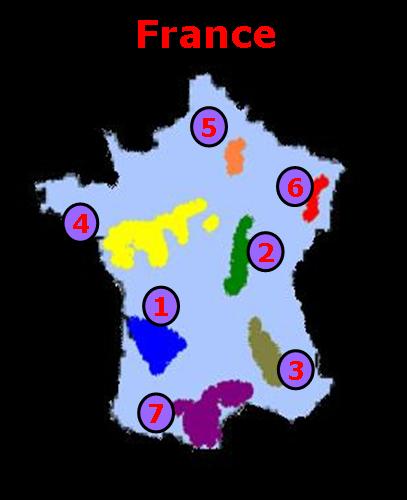
French Wine Regions
 RegionsKey Varietals
1 Bordeaux Cabernet Sauvignon and Merlot
2 Burgundy Chardonnay, Pinot Noir, Sauternes
3 Rhône Valley Syrah
4 Loire Valley Sauvignon Blanc, Chenin Blanc
5 Champagne Champagne
6 Alsace Riesling, Gewurztraminer, Pinot Gris, Muscat
7 Languedoc-Roussillon Carignan, Mourvèdre, Cinsault, Grenache

Appellation Classifications

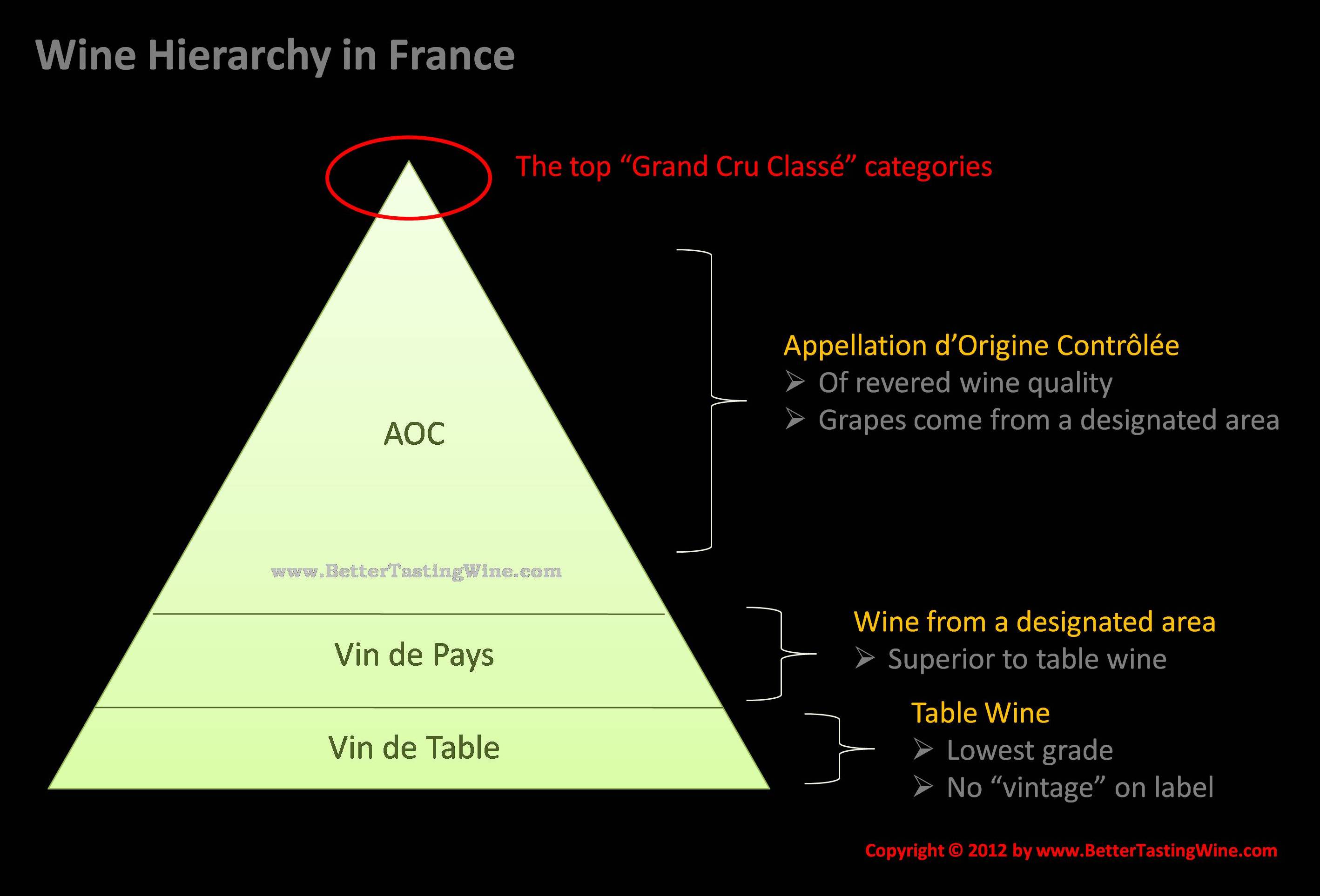
Administered by the Institut National des Appellations d'Origine (INAO), France's classification system was established in 1935 to fight trade frauds and to differentiate wine quality.

All French wines are categorized into 4 levels of quality:

  • Vin de table: Literally means "table wine". This is the lowest quality category. The wine, often blended, can be made from any French grapes.
  • Vin de pays: Village wine -- takes the characters of a specific region. Some wine producers love this loosely regulated category as it offers room for creativity.
  • Vin Délimité de Qualité Supérieure (VDQS): Not that many wines fall into this category. It is a graded-down version of AC.
  • Appelation d'Origine Contrôlée (AC or AOC): Wine subjects to rigid regional regulations on grape variety, yields per hectare, alcohol level, and production methods.

Over 30% of the wine produced in France is designated as AOC, <1% as VDQS, 25% as Vin de Pays, and the rest Vin de Table.

Many wine critics have complained that France's appellation system protects wine regions more than consumers. The strict regulation ensures producer compliance and protects the regional name and style; however it is not give consumers a full quality assurance that the wine will taste great.


Champagne

Champagne is the home to the sparkling wine the accompany all types of celebration. It is made from 1 white and 2 red grapes: Chardonnay, Pinot Noir, and Pinot Meunier.

Several practical knowledge on Champagne:

  • Champagne is usually non-vintage. Producers blend several vintages to achieve consistent quality. Non-vintage champagne can be drunk young; though further bottle aging will give it more roundness and color.

  • Vintage champagne is made in great years only. As 80% of the grapes come from one year, vintage champage is concentrated in flavor and best aged for a decade before drinking.

  • Champagne is classified by its levels of sweetness. Extra Brut means bone-dry with less than 0.5% of residual sugar per liter. Brut is the norm, with 0.5-1.5% of residual sugar. Sec despite meaning dry in French, is quite sweet with 2-3.5% residual sugar. Semi-Sec and Doux are even sweeter, with 3.5-5% and 5.5-8% sugar per liter.

  • There are over 100 companies (or marques in French) making Champagne. It is useful to know the Tête de Cuvée (top of line) for each marque. For example, Dom Perignon is the Tête de Cuvée of Moët et Chandon and La Grande Dame is the Tête de Cuvée of Veuve Clicquot.

  • Blanc de Blanc is the most delicate and lightest of all champagne. It is made solely from Chardonnay. As only one quarter of the land is designated to Chardonnay production, Blanc de Blanc commands a high price!

  • Blanc de Noir, on the other hand, is made solely with red Pinot Noir and Pinot Meunier. It has more complexity than the average non-vintage Champagne.

Return to Top of the Page


Bordeaux

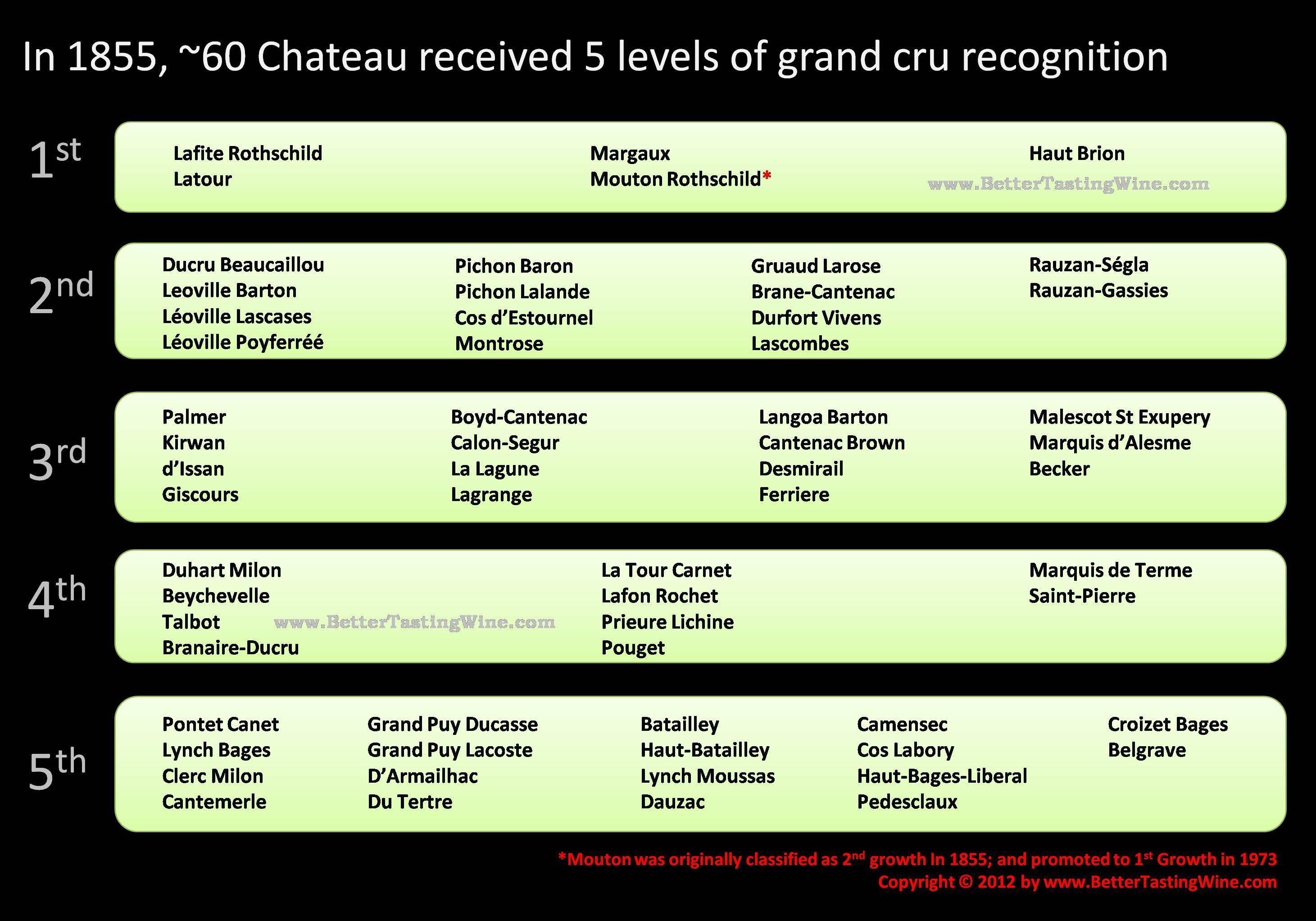
Bordeaux is the home to many of the world's most esteemed wine estates: Château Lafite-Rothschild, Château Latour, Château Margaux, Château Haut-Brion, Château Mouton-Rothschild, and Château Pétrus. It is also one of the most diverse wine producing regions. 304,000 acres (123,077 hectares) of land is dedicated to viticulture, spreading across Médoc, Graves, Sauternes and Entre-Deux Mers.

Bordeaux appellations

The river Gironde divides Bordeaux into two halves. The upper Left Bank regions (Haut-Médoc, Médoc, Pessac-Léognan) specialize in Cabernet Sauvignon. White wine dominates the southern Left Bank with Graves producing Sauvignon Blanc, and Sauternes / Barsac specializing in sweet wines. The Right Bank regions, namely Pomerol and St. Emillion, re famous for its Merlot.

Proud of its terroirs, French wines are labelled by appellations. You have probably seen the words Margaux and Pauillac on the labels of the most expensive reds. The table below indicates the grape varietals for the famous Bordeaux communeslations.

Sub-RegionsKey CommunesPrincipal Grapes
Haut-Médoc Pauillac, Margaux, St. Estèphe, St. Julien Cabernet Sauvignon (blend with Merlot)
Médoc Médoc
Graves Pessac-Léognan
Graves Sauvignon Blanc, Semillon
Sauternes / Barsac Barsac Semillon (botrytized)
Sauternes
Libournais (Right Bank) Pomerol, St. Emillion Merlot (blend with Cabernet Sauvignon)
*Source: Henderson & Rex, About Wine, Thomson Delmar Learning, © 2007

Return to Top of the Page


Burgundy

Burgundy, or Bourgogne, is the home of 3 distinctive wines: silky Pinot Noir, intense Chardonnay, and fruity Gamay (Beaujolais). Though one-third the size of Bordeaux, it is far more complex. As a result of the ancient inheritance laws requiring subdivision of land, each vineyard has many owners. So in addition to knowing vineyards, wine buyers have to know the owners or their négoçiants (agents).

Burgundy appellations

Burgundy is composed of 6 main regions: Chablis, Côte de Nuits, Côte de Beaune, Côte Chalonnaise, Beaujolais, and Mâconnais. Côte de Nuits and Côte de Beaune are the northern and southern parts of Côte d'Or -- the Golden Slope -- a region whose cool climate and elevated land make it one of the best home for the volatile Pinot Noir and complex Chardonnay.

The table below shows the grape variety for the common Burgundy regions:

Sub-RegionsKey CommunesPrincipal Grapes
Côte de Nuits Fixin, Gevrey, Morey-St. Denis, Chambolle-Musigny, Vougeot, Vosne-Romanée Pinot Noir
Nuits-St. Georges Pinot Noir, Chardonnay
Côte de Beaune Meursault, Puligny-Montrachet, Chassagne-Montrachet Chardonnay
Pommard, Volnay Pinot Noir
Beaune, Aloxe-Corton Chardonnay, Pinot Noir
Chablis Chablis Chardonnay
Côte Chalonnaise Givry Pinot Noir
Mercurey, Rully Pinot Noir, Chardonnay
Montagey Chardonnay
Mâconnais Pouilloy-Fuissé, St. Véran, Mâcon-Villages Chardonnay
Beaujolais St. Amour, Fleurie, Moulin-à-Vent, Brouilly, Côte de Brouilly, Julienas, Chenas, Regnie, Beaujolais-Villages Gamay
*Source: Henderson & Rex, About Wine, Thomson Delmar Learning, © 2007

Return to Top of the Page


Rhône Valley

Rhône Valley (or Côtes du Rhône) can be divided into two regions with different viticulture philosophy: Northern Rhône focues on one principal grape -- Syrah; Southern Rône produces blended wines, allowing as much as 13 grape varieties in some bottles. Thus Northern Rhône wine tends to have an intense, smokey character while the Southern wine assumes a rounder personality (The juicy Grenache grape is often used as a dominant blend).

Côtes du Rhône appellations

Hermitage, Côte Rôtie, Crozes-Hermitage, St. Joseph, and Cornas are the most well-known Northern Rhône communes focusing on Syrah. There are fine differences in these subregional wines. For example, Hermitage Syrah is well known for its deep color, intense nose, and full-bodied structure. Crozes-Hermitage, the largest appellation the northern region, offers softer Syrah, blending it the lighter Marsanne and Roussanne. Hidden amid these Syrah focused communes, the small Condrieu appellation produces Viognier. Because of the low production volume, Condrieu commands highest price for its dry white wine.

Majority of the wine in Southern Côtes du Rhône is red, though ~15% is dedicated to rosé and white. Key appellations include Coteaux du Tricastin, Châteauneuf-du-Pape, Vacqueryas, Gigondas, Tavel, Beaumes-de-Venise, Côtes du Ventoux, and Côtes du Lubéron. As mentioned earlier, southern Rhône reds are blended with many varietals. For example, reds from Châteauneuf-du-Pape (a well-known appellations) are composed of Grenache (50-70%), Syrah (10-30%), Cinsault, Mourvèdre and other reds (~20%) and Marsanne other white varietals (5-10%). In addition, Côtes du Ventoux is an appellation famous for its Vin Doux Naturel -- a delicious dessert wine made with the Muscat grapes.

Return to Top of the Page


Loire Valley

Loire Valley is better known for its white than reds. It is the home of Sauvignon Blanc, Chenin Blanc, and Muscadet.

Loire Valley appellations

Spread along the Loire River, Loire Valley is divided into four subregions: Upper Loire, Touraine, Anjou-Samur, and Muscadet.

The Upper Loire makes great Sauvignon Blanc, with esteemed appellations such as Sancerre and Pouilly-Fumé. Touraine makes a variety of red, white, rose, and sparkling wines. Vouvray is well-known for its fruity Chenin Blanc. Chinon and Bourgueil offer easy-to-drink Cabernet Franc based reds. Simple and light, Touraine reds are not meant to be aged.

Chenin Blanc is the primary grape of Anjou-Samur. Coteaux du Layon and Quarts de Chaume are the key communes making Chenin Blanc based sweet white wines. If you like to collect Chenin Blanc, look for Savennières -- its austere white wines will age into a complex, full white wine with fruity bouquet. In the Nantes region, Muscadet is the home to a simple, bone-dry white wine that has become a popular aperitif and seafood companion.

Return to Top of the Page


Alsace

Alsace is well-known for its variety of white wines: Riesling, Gewurztraminer, Pinot Gris, Muscat, Pinot Blanc, Chasselas, and Sylvaner. Pinot Noir is the only red grape grown in Alsace. Influenced by its German neighbors, Alsace labels wine by grape varietals and uses a tall, slender bottle. Despite its German reminiscence, Alsace wine is quite French in style -- aromatic and dry.

Useful to know: The Grand Cru appellation established in 1983 has loosen its quality standard. There are more than 50 qualifying vineyards, including some mediocre ones. In addition, there is no enforcement regulating the use of the Grand Cru labels. Large qualified estates with multiple terrains can label their wines Grand Cru regardless of quality difference. Many producers such as Trimbach and Beyer will not label its best wines Grand Crus.

Return to Top of the Page


Languedoc-Roussillon

The region, aka Midi, produces majority of France's vin ordinaire and vin de pays. Its principal grapes are Carignan, Mourvèdre, Cinsault, and Grenache.

In the recent decade, Languedoc-Roussillon wine has improved dramatically in quality. Australian and other international wine companies have invested in the region (in particular Vin de Pays d'Oc) and influenced viticulture with their modern-world technology. Compared to its neighbors, wine from Vin de Pays d'Oc has a softer and rounder New World style.

«« Return to Wine Regions                                             »» Proceed to Italy


  • Top of the Page
  • Home
  • Lesson Guide
  • Useful Tools
  • Fun Stuff
  • About Us
  • Contact Us

Copyright ©2006 Bettertastingwine.com